
When Past Success Becomes an organizational constraint

The Brief: Organizations can become attached to decisions, structures, and behaviours that once produced success. What worked in the past becomes the default answer for the future, even when the conditions that made it effective have changed.
This reflects a pattern known as path dependency: earlier choices shape what leaders see, which options feel possible, and how the organization moves.
Path dependency is difficult to recognize because it rarely announces itself. It can appear in routines that no longer create the same value, structures that once brought clarity but now create friction, and assumptions about “how we do things here” that limit the organization’s ability to adapt.
Over time, these patterns can harden into organizational lock-in, where the organization continues along a familiar path even as the environment and internal realities around it change.
What appears to be an execution problem—a lack of accountability, discipline, or follow-through—may have a different source. The organization may be trying to respond to current conditions through assumptions, structures, and ways of working shaped by an earlier period.
The result is not necessarily immediate failure. It can be gradual misalignment between what the organization needs to do and how it has learned to operate.
How Paths Form Inside Organizations
Path dependency begins with choices.
Decisions about markets, technologies, structures, investments, or ways of working establish an initial direction. As the organization invests further in that direction, systems, skills, relationships, and routines develop around it.
Research by Jörg Sydow, Georg Schreyögg, and Jochen Koch describes organizational path dependence as a process that develops through three broad phases:
Path formation – Initial decisions and investments create a direction of travel.
Self-reinforcement – Routines, structures, and successes develop around that direction.
Lock-in – Alternatives become harder to see and harder to justify, even when they may be better suited to current conditions.

Organizational Path Dependence: Opening The Black Box, Academy of Management Review, Jörg Sydow, Georg Schreyögg and Jochen Koch, 2009
The important mechanism is self-reinforcement.
An initial decision does not determine everything that follows. But as resources are committed, capabilities developed, people rewarded, and success associated with a particular approach, continuing along the existing path can become increasingly attractive.
Changing direction can also become increasingly difficult.
The organization has invested in the existing model. People have developed expertise within it. Responsibilities and relationships reflect it. Previous success provides evidence that the model works.
What began as one possible direction can gradually become the way the organization understands what makes sense.
When Success Starts to Narrow Options
Path dependency is particularly difficult to recognize because the path itself may have been created through success.
A strategy that accelerated growth can become the mental template for evaluating new opportunities. A structure that helped leaders move quickly can become less effective as the organization grows. Leadership behaviours that created confidence under one set of circumstances can become less effective as responsibilities and complexity change.
None of these began as mistakes.
That is precisely what makes them difficult to question.
Success provides evidence for continuing to do what has worked. It strengthens confidence in existing assumptions and encourages further investment in the capabilities, systems, and behaviours associated with them.
But the conditions that produced earlier success do not necessarily remain constant.
Markets change. Technologies develop. Organizations grow. Customer expectations shift. New competitors emerge. Strategy evolves.
The question is not whether the earlier path was wrong. It is whether the conditions that made it effective still exist.
A Familiar Story: Kodak and the Cost of Staying on the Path
Kodak is frequently used as an example of an organization that failed to respond to digital photography. The reality is more complicated.
Research by Natalya Vinokurova and Rahul Kapoor traces Kodak’s engagement with digital transformation across several decades, revealing a much longer process of experimentation, investment, adaptation, uncertainty, and inertia than the familiar story of a company simply refusing to embrace a new technology suggests.
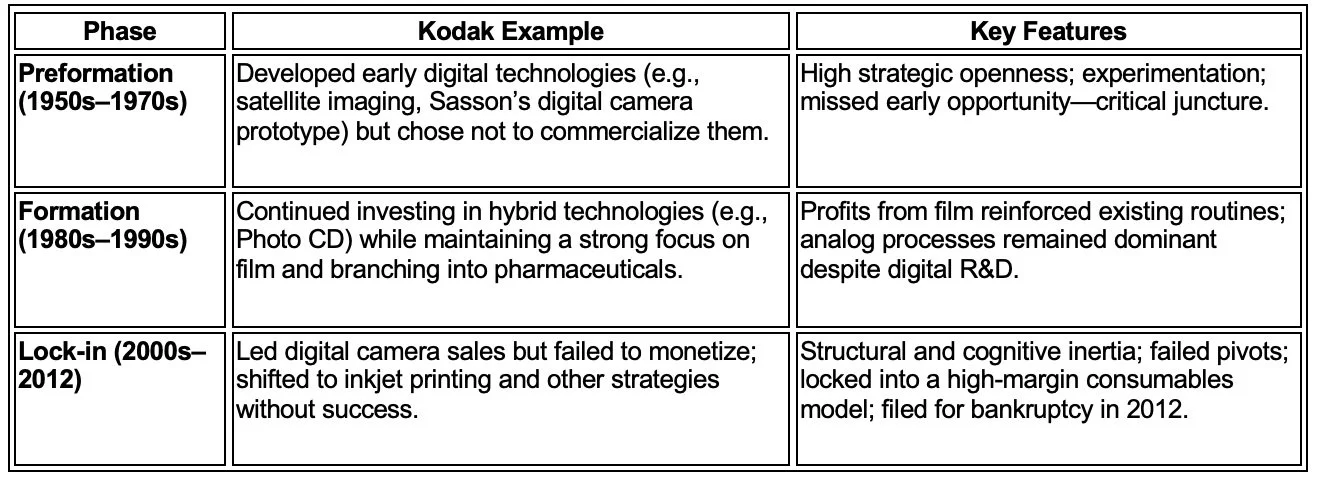
Kodak’s Surprisingly Long Journey Toward Strategic Renewal: A Half Century Exploring Digital Transformation in the Face of Uncertainty and Inertia, The Wharton School, Management Department, University of Pennsylvania, Natalya Vinokurova and Rahul Kapoor, 2022
That distinction is important.
Path dependency does not necessarily mean leaders cannot see change occurring around them. Organizations can recognize emerging threats, invest in new capabilities, and experiment with alternatives while still remaining strongly influenced by the assumptions and commitments associated with the existing path.
Earlier success shapes more than what an organization does. It can shape how new possibilities are interpreted and how difficult moving away from the existing model appears.
Kodak is useful not because it provides a simple warning against resisting change, but because it illustrates how difficult strategic renewal can become when new possibilities emerge within an organization whose capabilities, investments, and understanding of value have developed around an established path.
The Drift Between Strategy and Execution
Strategic drift rarely appears suddenly.
It can develop as the environment changes and the organization continues operating through assumptions established under earlier conditions.
At first, the signs may appear relatively minor. Decisions take longer. Work requires more coordination. Leaders become increasingly involved in resolving issues across organizational boundaries. Existing processes require exceptions or workarounds. New initiatives are introduced, but the underlying way the organization operates remains largely unchanged.
Individually, these can look like execution problems.
The natural response may be to push harder: clarify priorities, increase accountability, introduce another initiative, or ask teams to collaborate more effectively.
Those responses may be appropriate. But they may also leave the underlying path untouched.
If responsibilities, incentives, structures, investments, or established assumptions continue reinforcing the existing way of operating, asking people to behave differently may have limited effect.
The organization is being asked to move in a new direction while many of the conditions within it continue pointing toward the old one.
Recognizing Organizational Lock-In
Lock-in does not mean an organization has no alternatives. It means those alternatives become increasingly difficult to see, justify, or pursue.
One indication is when explanations for maintaining the existing approach rely heavily on its history:
This is how we have always done it.
Our customers expect this.
This model has always worked for us.
Changing it would be too disruptive.
Each statement may contain legitimate concerns. The issue is whether assumptions inherited from the past are still being tested against current conditions.
Lock-in can also appear when attempts to change repeatedly reproduce the existing model. New roles are created, but decision authority remains unchanged. New strategies are announced, but investments continue to favour established priorities. Leaders ask for greater collaboration while incentives continue rewarding functional outcomes.
The visible organization changes. The conditions reinforcing the path do not.
Recognizing lock-in requires looking beneath individual initiatives and asking what continues to make the existing path easier to follow than the alternatives.
Unlocking the Path
Organizational lock-in is unlikely to be resolved simply by adding more initiatives on top of the existing path.
Leaders need to examine the conditions that continue reinforcing it.
Which assumptions still shape important decisions? Where does authority sit, and does that still make sense? What behaviours and outcomes are rewarded? Which investments or capabilities make the existing model easier to continue? Where do structures and responsibilities reflect requirements that may no longer exist?
These questions are not an argument for abandoning the past.
Organizations accumulate valuable capabilities, relationships, knowledge, and experience precisely because they have followed particular paths. The challenge is distinguishing between what remains valuable and what is being preserved primarily because the organization has become accustomed to it.
Breaking lock-in may require changing structures, reallocating resources, moving decision authority, developing different capabilities, or questioning assumptions that have become embedded in how the organization operates.
The objective is not change for its own sake. It is to create enough room for alternatives to become visible and possible.
The Work of Letting Go
Path dependency reminds us that organizations rarely arrive where they are because of a single decision.
They develop over time.
Earlier choices influence later ones. Success reinforces particular approaches. Investments accumulate. Structures and behaviours form around them. Eventually, ways of operating that were once deliberate choices can begin to feel inevitable.
That history matters. But it should not become destiny.
Leadership is not simply about choosing a direction. It also requires continually testing whether the assumptions, structures, and ways of working supporting that direction still fit the environment and the organization.
For leaders, the difficult question is not simply what needs to change?
It is also what inside the organization continues to reproduce the way things are now?
Changing direction may ultimately require more than deciding on a new path. It may require changing the conditions that keep pulling the organization back toward the old one.
1. Clio and the Economics of QWERTY, The American Economic Review, Paul A. David, 1985 2. Organizational Path Dependence: Opening The Black Box, Academy of Management Review, Jörg Sydow, Georg Schreyögg and Jochen Koch, 2009. 3. Resilience and Stability of Ecological Systems, Annual Review of Ecology and Systematics, C.S. Holling, 1973. 4. Kodak’s Surprisingly Long Journey Toward Strategic Renewal: A Half Century Exploring Digital Transformation in the Face of Uncertainty and Inertia, The Wharton School, Management Department, University of Pennsylvania, Natalya Vinokurova and Rahul Kapoor, 2022. 5. The Dominant Logic: A New Linkage Between Diversity and Performance, Prahalad and Bettis, 1986, 6. Managing the Unexpected: Assuring High Performance in an Age of Complexity, Weick K.E. and Sutcliffe K.M., 2001, 7. Psychological Safety and Learning Behavior in Work Teams, Edmonson, A. C., 1999, 8. Organizational Learning: A Theory of Action Perspective, Argyris, C. and Schön, D. A., 1978 and 11. Ambidextrous Organizations: Managing Evolutionary and Revolutionary Change, Tushman, M. L. & O’Reilly, C. A., 1996.